Market Regulations By Roger Sherman Download Free Pdf Book UPDATED
Market Regulations By Roger Sherman Download Free Pdf Book
In economics, a free marketplace is a system in which the prices for appurtenances and services are self-regulated by buyers and sellers negotiating in an open market without market coercions. In a free market place, the laws and forces of supply and demand are gratuitous from any intervention by a government or other authority other than those interventions which are made to prohibit market coercions. Examples of such prohibited market coercions include: economic privilege, monopolies, and artificial scarcities.[one] Proponents of the concept of free market contrast it with a regulated market place in which a government intervenes in the exchange of holding for any reason other than reducing market coercions.
Scholars contrast the concept of a free market with the concept of a coordinated market in fields of study such every bit political economic system, new institutional economics, economic sociology and political science. All of these fields emphasize the importance in currently existing market systems of rule-making institutions external to the simple forces of supply and demand which create space for those forces to operate to control productive output and distribution. Although gratuitous markets are commonly associated with capitalism in contemporary usage and popular civilization, costless markets accept also been components in some forms of market socialism.[2]
Criticism of the theoretical concept may regard realities of the difficulty of regulating systems to forbid meaning market authority, inequality of bargaining power, or data disproportion, in social club to allow markets to function more than freely.
Historically, free market place has also been used synonymously with other economic policies. For instance proponents of laissez-faire capitalism, may refer to it as free market capitalism because they merits it to achieve the most economic liberty.[one]
Economic systems [edit]
Capitalism [edit]
Capitalism is an economic system based on the private ownership of the ways of production and their operation for profit.[3] [4] [5] [half dozen] Key characteristics of capitalism include capital accumulation, competitive markets, a price system, individual belongings and the recognition of property rights, voluntary exchange and wage labor.[7] [8] In a capitalist market economy, controlling and investments are adamant by every owner of wealth, property or production ability in majuscule and financial markets whereas prices and the distribution of goods and services are mainly determined by competition in goods and services markets.[ix]
Economists, historians, political economists and sociologists have adopted different perspectives in their analyses of capitalism and take recognized various forms of it in practise. These include laissez-faire or free-market capitalism, state capitalism and welfare capitalism. Unlike forms of capitalism feature varying degrees of free markets, public ownership,[10] obstacles to free contest and state-sanctioned social policies. The caste of contest in markets and the office of intervention and regulation every bit well equally the scope of state ownership vary across different models of capitalism.[11] [12] The extent to which different markets are free and the rules defining private property are matters of politics and policy. Most of the existing capitalist economies are mixed economies that combine elements of free markets with state intervention and in some cases economic planning.[xiii]
Market place economies have existed under many forms of authorities and in many different times, places and cultures. Modern capitalist societies—marked past a universalization of coin-based social relations, a consistently big and arrangement-wide grade of workers who must work for wages (the proletariat) and a capitalist class which owns the means of production—developed in Western Europe in a process that led to the Industrial Revolution. Capitalist systems with varying degrees of directly regime intervention have since become ascendant in the Western world and continue to spread. Capitalism has been shown to be strongly correlated with economical growth.[14]
Georgism [edit]
For classical economists such equally Adam Smith, the term free market refers to a market costless from all forms of economical privilege, monopolies and artificial scarcities.[one] They say this implies that economic rents, which they draw as profits generated from a lack of perfect competition, must exist reduced or eliminated as much as possible through free competition.
Economical theory suggests the returns to land and other natural resources are economic rents that cannot be reduced in such a way because of their perfect inelastic supply.[15] Some economical thinkers emphasize the need to share those rents as an essential requirement for a well performance market. It is suggested this would both eliminate the need for regular taxes that have a negative effect on merchandise (run across deadweight loss) equally well equally release land and resources that are speculated upon or monopolised, two features that improve the competition and free market mechanisms. Winston Churchill supported this view past the following argument: "State is the female parent of all monopoly".[xvi] The American economist and social philosopher Henry George, the most famous proponent of this thesis, wanted to achieve this through a high land value revenue enhancement that replaces all other taxes.[17] Followers of his ideas are often called Georgists or geoists and geolibertarians.
Léon Walras, one of the founders of the neoclassical economics who helped formulate the general equilibrium theory, had a very like view. He argued that free contest could just be realized under weather condition of state buying of natural resource and state. Additionally, income taxes could be eliminated because the state would receive income to finance public services through owning such resources and enterprises.[18]
Laissez-faire [edit]
The laissez-faire principle expresses a preference for an absence of non-market place pressures on prices and wages such equally those from discriminatory regime taxes, subsidies, tariffs, regulations, or authorities-granted monopolies. In The Pure Theory of Capital, Friedrich Hayek argued that the goal is the preservation of the unique information contained in the toll itself.[19]
Co-ordinate to Karl Popper, the idea of the gratis market is paradoxical, as it requires interventions towards the goal of preventing interventions.[1]
Although laissez-faire has been commonly associated with capitalism, there is a similar economic theory associated with socialism called left-fly or socialist laissez-faire, also known as gratuitous-market anarchism, gratis-marketplace anti-commercialism and free-market socialism to distinguish it from laissez-faire capitalism.[20] [21] [22] Critics of laissez-faire as commonly understood argue that a truly laissez-faire organization would be anti-capitalist and socialist.[23] [24] American individualist anarchists such as Benjamin Tucker saw themselves as economic free-market socialists and political individualists while arguing that their "anarchistic socialism" or "individual anarchism" was "consistent Manchesterism".[25]
[edit]
Diverse forms of socialism based on free markets have existed since the 19th century. Early notable socialist proponents of free markets include Pierre-Joseph Proudhon, Benjamin Tucker and the Ricardian socialists. These economists believed that genuinely complimentary markets and voluntary substitution could not exist within the exploitative weather condition of capitalism. These proposals ranged from various forms of worker cooperatives operating in a free-market economic system such as the mutualist system proposed by Proudhon, to state-owned enterprises operating in unregulated and open markets. These models of socialism are not to be confused with other forms of market socialism (e.thou. the Lange model) where publicly owned enterprises are coordinated by various degrees of economic planning, or where capital skilful prices are adamant through marginal cost pricing.
Advocates of gratis-market socialism such as Jaroslav Vanek argue that genuinely free markets are not possible under conditions of private ownership of productive property. Instead, he contends that the grade differences and inequalities in income and ability that upshot from individual buying enable the interests of the dominant class to skew the market to their favor, either in the form of monopoly and market power, or by utilizing their wealth and resource to legislate regime policies that benefit their specific business interests. Additionally, Vanek states that workers in a socialist economic system based on cooperative and self-managed enterprises take stronger incentives to maximize productivity because they would receive a share of the profits (based on the overall performance of their enterprise) in addition to receiving their fixed wage or salary. The stronger incentives to maximize productivity that he conceives every bit possible in a socialist economy based on cooperative and self-managed enterprises might be accomplished in a free-market economy if employee-endemic companies were the norm equally envisioned by diverse thinkers including Louis O. Kelso and James Due south. Albus.[26]
Socialists as well assert that free-market capitalism leads to an excessively skewed distributions of income and economical instabilities which in turn leads to social instability. Corrective measures in the class of social welfare, re-distributive revenue enhancement and regulatory measures and their associated authoritative costs which are required create agency costs for guild. These costs would not exist required in a self-managed socialist economy.
Concepts [edit]
Economic equilibrium [edit]
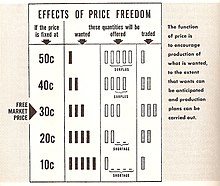
A diagram showing the "effects of price freedom"
The general equilibrium theory has demonstrated that, under certain theoretical conditions of perfect competition, the law of supply and demand influences prices toward an equilibrium that balances the demands for the products against the supplies.[28] [ full citation needed ] At these equilibrium prices, the market distributes the products to the purchasers according to each purchaser'south preference or utility for each product and inside the relative limits of each buyer's purchasing power. This issue is described every bit market efficiency, or more specifically a Pareto optimum.
Low barriers to entry [edit]
A free marketplace does non direct require the existence of contest; however, it does require a framework that freely allows new market entrants. Hence, competition in a gratis marketplace is a consequence of the conditions of a free marketplace, including that market participants not be obstructed from following their turn a profit motive.
Perfect competition and marketplace failure [edit]
An absence of any of the conditions of perfect competition is considered a market failure. Regulatory intervention may provide a substitute force to counter a marketplace failure, which leads some economists to believe that some forms of market regulation may be ameliorate than an unregulated market at providing a free marketplace.[i]
Spontaneous order [edit]
Friedrich Hayek popularized the view that market place economies promote spontaneous order which results in a better "allocation of societal resources than any design could achieve".[29] Co-ordinate to this view, market economies are characterized past the formation of complex transactional networks that produce and distribute goods and services throughout the economy. These networks are not designed, but they nevertheless emerge as a result of decentralized individual economical decisions. The thought of spontaneous social club is an elaboration on the invisible hand proposed by Adam Smith in The Wealth of Nations. About the private, Smith wrote:
By preferring the support of domestic to that of foreign industry, he intends only his own security; and by directing that industry in such a manner as its produce may be of the greatest value, he intends only his own gain, and he is in this, as in many other cases, led by an invisible hand to promote an end which was no role of his intention. Nor is information technology always the worse for society that it was no part of information technology. By pursuing his ain interest, he oft promotes that of the society more than around than when he really intends to promote it. I take never known much good done by those who affected to merchandise for the public good.[xxx]
Smith pointed out that one does not get i'south dinner by appealing to the brother-dear of the butcher, the farmer or the baker. Rather, i appeals to their self-interest and pays them for their labor, arguing:
Information technology is not from the benignancy of the butcher, the brewer or the baker, that nosotros expect our dinner, only from their regard to their own self-interest. We address ourselves, non to their humanity but to their self-love, and never talk to them of our ain necessities but of their advantages.[31]
Supporters of this view claim that spontaneous social club is superior to whatever order that does non allow individuals to make their own choices of what to produce, what to purchase, what to sell and at what prices due to the number and complication of the factors involved. They further believe that whatever attempt to implement central planning will result in more disorder, or a less efficient production and distribution of appurtenances and services.
Critics such as political economist Karl Polanyi question whether a spontaneously ordered marketplace tin exist, completely complimentary of distortions of political policy, challenge that even the ostensibly freest markets require a state to exercise coercive power in some areas, namely to enforce contracts, govern the formation of labor unions, spell out the rights and obligations of corporations, shape who has standing to bring legal actions and define what constitutes an unacceptable disharmonize of interest.[32]
Supply and demand [edit]
Need for an item (such equally goods or services) refers to the economic market place force per unit area from people trying to buy information technology. Buyers have a maximum price they are willing to pay for an detail, and sellers have a minimum price at which they are willing to offer their product. The indicate at which the supply and demand curves meet is the equilibrium price of the good and quantity demanded. Sellers willing to offering their goods at a lower price than the equilibrium toll receive the divergence as producer surplus. Buyers willing to pay for goods at a college price than the equilibrium toll receive the departure as consumer surplus.[33]
The model is normally applied to wages in the market place for labor. The typical roles of supplier and consumer are reversed. The suppliers are individuals, who endeavor to sell (supply) their labor for the highest price. The consumers are businesses, which attempt to buy (need) the type of labor they need at the everyman toll. As more people offer their labor in that market place, the equilibrium wage decreases and the equilibrium level of employment increases every bit the supply curve shifts to the right. The opposite happens if fewer people offer their wages in the market equally the supply curve shifts to the left.[33]
In a free market, individuals and firms taking function in these transactions accept the liberty to enter, leave and participate in the market as they so choose. Prices and quantities are immune to adjust according to economic conditions in order to accomplish equilibrium and allocate resources. Still, in many countries effectually the world governments seek to intervene in the complimentary market place in social club to achieve certain social or political agendas.[34] Governments may effort to create social equality or equality of consequence past intervening in the market through actions such equally imposing a minimum wage (price floor) or erecting price controls (price ceiling). Other lesser-known goals are as well pursued, such as in the The states, where the federal government subsidizes owners of fertile state to not grow crops in order to prevent the supply bend from further shifting to the right and decreasing the equilibrium price. This is done nether the justification of maintaining farmers' profits; due to the relative inelasticity of need for crops, increased supply would lower the price but not significantly increase quantity demanded, thus placing pressure on farmers to get out the market.[35] Those interventions are oftentimes done in the proper noun of maintaining bones assumptions of free markets such equally the idea that the costs of product must be included in the price of goods. Pollution and depletion costs are sometimes not included in the cost of production (a manufacturer that withdraws h2o at one location and so discharges it polluted downstream, avoiding the cost of treating the water), therefore governments may opt to impose regulations in an attempt to endeavor to internalize all of the toll of product and ultimately include them in the price of the goods.
Advocates of the complimentary market contend that government intervention hampers economic growth past disrupting the efficient resource allotment of resources according to supply and demand while critics of the free market place contend that government intervention is sometimes necessary to protect a country's economy from better-developed and more than influential economies, while providing the stability necessary for wise long-term investment. Milton Friedman argued against primal planning, price controls and state-owned corporations, especially equally adept in the Soviet Matrimony and Mainland china[36] while Ha-Joon Chang cites the examples of post-war Nippon and the growth of Republic of korea'southward steel manufacture as positive examples of regime intervention.[37]
Criticism [edit]
Critics of a laissez-faire free market have argued that in existent globe situations it has proven to exist susceptible to the development of price fixing monopolies.[38] Such reasoning has led to authorities intervention, e.g. the United states of america antitrust police.
Two prominent Canadian authors contend that government at times has to intervene to ensure competition in large and of import industries. Naomi Klein illustrates this roughly in her work The Shock Doctrine and John Ralston Saul more than humorously illustrates this through diverse examples in The Collapse of Globalism and the Reinvention of the World.[39] While its supporters argue that but a free market can create healthy competition and therefore more than business and reasonable prices, opponents say that a gratuitous market in its purest course may result in the opposite. According to Klein and Ralston, the merging of companies into behemothic corporations or the privatization of government-run industry and national assets oftentimes outcome in monopolies or oligopolies requiring government intervention to force competition and reasonable prices.[39] Some other form of market failure is speculation, where transactions are made to profit from short term fluctuation, rather from the intrinsic value of the companies or products. This criticism has been challenged by historians such as Lawrence Reed, who argued that monopolies have historically failed to form even in the absence of antitrust law.[twoscore] [ unreliable source? ] This is because monopolies are inherently difficult to maintain as a company that tries to maintain its monopoly by buying out new competitors, for instance, is incentivizing newcomers to enter the market in hope of a buy-out. Furthermore, according to writer Walter Lippman and economist Milton Friedman, historical analysis of the germination of monopolies reveals that, reverse to popular conventionalities, these were the result not of unfettered market forces, but of legal privileges granted past government.[41] [ unreliable source? ]
American philosopher and author Cornel Westward has derisively termed what he perceives as dogmatic arguments for laissez-faire economical policies equally free-market fundamentalism. West has contended that such mentality "trivializes the concern for public interest" and "makes coin-driven, poll-obsessed elected officials deferential to corporate goals of turn a profit – often at the cost of the common good".[42] American political philosopher Michael J. Sandel contends that in the last 30 years the U.s. has moved across just having a market place economy and has go a marketplace society where literally everything is for sale, including aspects of social and civic life such as education, access to justice and political influence.[43] The economic historian Karl Polanyi was highly disquisitional of the idea of the marketplace-based order in his book The Great Transformation, noting that any attempt at its cosmos would undermine human club and the mutual good.[44]
David McNally of the Academy of Houston argues in the Marxist tradition that the logic of the market inherently produces inequitable outcomes and leads to unequal exchanges, arguing that Adam Smith's moral intent and moral philosophy espousing equal substitution was undermined by the practise of the gratuitous market he championed. According to McNally, the development of the market economy involved coercion, exploitation and violence that Smith's moral philosophy could not eyebrow. McNally also criticizes market socialists for assertive in the possibility of fair markets based on equal exchanges to be accomplished by purging parasitical elements from the market economic system such as private ownership of the means of production, arguing that market socialism is an oxymoron when socialism is defined equally an finish to wage labour.[45]
Some[ who? ] would argue that but one known instance of a true free market exists, namely the black marketplace. The black market is under abiding threat past the police, but under no circumstances do the police regulate the substances that are being created. The black market produces wholly unregulated goods and are purchased and consumed unregulated. That is to say, anyone can produce anything at any time and anyone tin can purchase anything available at whatever time. The culling view is that the black market is not a gratuitous market at all since loftier prices and natural monopolies are often enforced through murder, theft and destruction. Black markets can only exist peripheral to regulated markets where laws are being regularly enforced.[ citation needed ]
See too [edit]
- Binary economic science
- Crony commercialism
- Economic liberalism
- Liberty of selection
- Free cost arrangement
- Greyness market
- Left-wing market anarchism
- Market place economy
- Neoliberalism
- Participatory economics
- Quasi-market
- Self-managed economy
- Transparency (market)
Notes [edit]
- ^ a b c d due east Popper, Karl (1994). The Open Society and Its Enemies. Routledge Classics. p. 712. ISBN978-0-415-61021-6.
- ^ Bockman, Johanna (2011). Markets in the name of Socialism: The Left-Wing origins of Neoliberalism. Stanford University Press. ISBN978-0-8047-7566-iii.
- ^ Zimbalist, Sherman and Brown, Andrew, Howard J. and Stuart (Oct 1988). Comparing Economic Systems: A Political-Economic Approach. Harcourt College Pub. pp. 6–7. ISBN978-0-xv-512403-five.
Pure commercialism is defined every bit a system wherein all of the means of product (concrete upper-case letter) are privately endemic and run by the capitalist course for a profit, while most other people are workers who work for a salary or wage (and who do not own the capital or the product).
- ^ Rosser, Mariana 5.; Rosser, J Barkley (23 July 2003). Comparative Economics in a Transforming World Economy. MIT Press. p. 7. ISBN978-0-262-18234-eight.
In capitalist economies, land and produced ways of production (the uppercase stock) are owned by private individuals or groups of private individuals organized equally firms.
- ^ Chris Jenks. Core Sociological Dichotomies. "Capitalism, equally a mode of product, is an economic arrangement of manufacture and commutation which is geared toward the production and auction of commodities inside a marketplace for profit, where the manufacture of commodities consists of the employ of the formally free labor of workers in exchange for a wage to create commodities in which the manufacturer extracts surplus value from the labor of the workers in terms of the difference between the wages paid to the worker and the value of the commodity produced by him/her to generate that profit." London; Yard Oaks, CA; New Delhi. Sage. p. 383.
- ^ Gilpin, Robert (5 June 2018). The Challenge of Global Commercialism : The World Economy in the 21st Century. ISBN9780691186474. OCLC 1076397003.
- ^ Heilbroner, Robert Fifty. "Capitalism" Archived 28 Oct 2017 at the Wayback Machine. Steven Due north. Durlauf and Lawrence E. Blume, eds. The New Palgrave Dictionary of Economic science. 2nd ed. (Palgrave Macmillan, 2008) doi:ten.1057/9780230226203.0198.
- ^ Louis Hyman and Edward E. Baptist (2014). American Commercialism: A Reader Archived 22 May 2015 at the Wayback Machine. Simon & Schuster. ISBN 978-1-4767-8431-1.
- ^ Gregory, Paul; Stuart, Robert (2013). The Global Economy and its Economical Systems. Due south-Western Higher Pub. p. 41. ISBN978-1-285-05535-0.
Commercialism is characterized by individual ownership of the factors of product. Determination making is decentralized and rests with the owners of the factors of production. Their conclusion making is coordinated past the marketplace, which provides the necessary information. Material incentives are used to motivate participants.
- ^ Gregory and Stuart, Paul and Robert (28 Feb 2013). The Global Economy and its Economic Systems. South-Western College Pub. p. 107. ISBN978-1-285-05535-0.
Real-world backer systems are mixed, some having higher shares of public ownership than others. The mix changes when privatization or nationalization occurs. Privatization is when property that had been state-owned is transferred to individual owners. Nationalization occurs when privately endemic property becomes publicly endemic.
- ^ Macmillan Dictionary of Modern Economics, 3rd Ed., 1986, p. 54.
- ^ Bronk, Richard (Summer 2000). "Which model of capitalism?". OECD Observer. Vol. 1999, no. 221–22. OECD. pp. 12–15. Archived from the original on 6 April 2018. Retrieved six Apr 2018.
- ^ Stilwell, Frank. "Political Economic system: the Competition of Economic Ideas". First Edition. Oxford Academy Press. Melbourne, Australia. 2002.
- ^ Sy, Wilson N. (eighteen September 2016). "Commercialism and Economical Growth Across the World". Rochester, NY. SSRN 2840425.
For 40 largest countries in the International Monetary Fund (Imf) database, information technology is shown statistically that commercialism, between 2003 and 2012, is positively correlated significantly to economic growth.
- ^ Adam Smith, The Wealth of Nations Book V, Chapter 2, Part ii, Commodity I: Taxes upon the Hire of Houses.
- ^ Firm Of Commons May 4th; Male monarch'southward Theatre, Edinburgh, July 17
- ^ Backhaus, "Henry George's Ingenious Tax," pp. 453–58.
- ^ Bockman, Johanna (2011). Markets in the name of Socialism: The Left-Wing origins of Neoliberalism. Stanford University Press. p. 21. ISBN978-0-8047-7566-iii.
For Walras, socialism would provide the necessary institutions for costless competition and social justice. Socialism, in Walras'due south view, entailed country ownership of land and natural resources and the abolition of income taxes. As possessor of land and natural resources, the state could then lease these resources to many individuals and groups which would eliminate monopolies and thus enable gratuitous competition. The leasing of land and natural resources would also provide enough country acquirement to make income taxes unnecessary, allowing a worker to invest his savings and become 'an owner or capitalist at the same fourth dimension that he remains a worker.
- ^ Hayek, Friedrich (1941). The Pure Theory of Capital.
- ^ Chartier, Gary; Johnson, Charles W. (2011). Markets Non Capitalism: Individualist Anarchism Confronting Bosses, Inequality, Corporate Power, and Structural Poverty. Brooklyn, NY:Minor Compositions/Autonomedia
- ^ "It introduces an eye-opening arroyo to radical social thought, rooted equally in libertarian socialism and marketplace riot." Chartier, Gary; Johnson, Charles W. (2011). Markets Non Capitalism: Individualist Anarchism Against Bosses, Inequality, Corporate Power, and Structural Poverty. Brooklyn, NY: Small-scale Compositions/Autonomedia. p. back embrace.
- ^ "But there has always been a market place-oriented strand of libertarian socialism that emphasizes voluntary cooperation between producers. And markets, properly understood, accept always been about cooperation. As a commenter at Reason magazine's Hit&Run blog, remarking on Jesse Walker's link to the Kelly article, put it: "every trade is a cooperative act." In fact, it'south a fairly common observation amongst marketplace anarchists that genuinely free markets have the most legitimate claim to the label "socialism." "Socialism: A Perfectly Good Word Rehabilitated" by Kevin Carson at website of Center for a Stateless Order.
- ^ Nick Manley, "Brief Introduction To Left-Wing Laissez Faire Economic Theory: Part One".
- ^ Nick Manley, "Cursory Introduction To Left-Fly Laissez Faire Economic Theory: Function Two".
- ^ Tucker, Benjamin (1926). Private Liberty: Selections from the Writings of Benjamin R. Tucker. New York: Vanguard Press. pp. 1–19.
- ^ "Cooperative Economics: An Interview with Jaroslav Vanek". Interview by Albert Perkins. Retrieved March 17, 2011.
- ^ Theory of Value past Gérard Debreu.
- ^ Hayek cited. Petsoulas, Christina. Hayek'due south Liberalism and Its Origins: His Idea of Spontaneous Social club and the Scottish Enlightenment. Routledge. 2001. p. 2.
- ^ Smith, Adam (1827). The Wealth of Nations. Volume Four. p. 184.
- ^ Smith, Adam (1776). "2". The Wealth of Nations. Vol. 1. London: Westward. Strahan and T. Cadell.
- ^ Hacker, Jacob Due south.; Pierson, Paul (2010). Winner-Take-All Politics: How Washington Made the Rich Richer – and Turned Its Back on the Centre Class. Simon & Schuster. p. 55.
- ^ a b Judd, Thousand. L. (1997). "Computational economics and economic theory: Substitutes or complements?" (PDF). Journal of Economic Dynamics and Control. 21 (half-dozen): 907–42. doi:10.1016/S0165-1889(97)00010-9. S2CID 55347101.
- ^ "Archived copy". Archived from the original on 2014-05-22. Retrieved 2014-06-06 .
{{cite web}}: CS1 maint: archived copy as championship (link) - ^ "Subcontract Program Pays $one.iii Billion to People Who Don't Farm". Washington Post. 2 July 2006. Retrieved 3 June 2014.
- ^ Ip, Greg and Mark Whitehouse, "How Milton Friedman Changed Economics, Policy and Markets", Wall Street Journal Online (November 17, 2006).
- ^ "Bad Samaritans: The Myth of Free Trade and the Secret History of Capitalism", Ha-Joon Chang, Bloomsbury Press, ISBN 978-1596915985
- ^ Tarbell, Ida (1904). The History of the Standard Oil Company. McClure, Phillips and Co.
- ^ a b Saul, John The End of Globalism.
- ^ "Cliche #41: "Rockefeller'southward Standard Oil Visitor Proved That We Needed Anti-Trust Laws to Fight Such Marketplace Monopolies", The Freeman, January 23, 2015. Retrieved Dec xx, 2016.
- ^ "Why Nosotros Need To Re-think Friedman's Ideas Nearly Monopolies". ProMarket. 2021-04-25. Retrieved 2021-09-27 .
- ^ "Cornel West: Commonwealth Matters", The Globalist, January 24, 2005. Retrieved Oct ix, 2014.
- ^ Michael J. Sandel (June 2013). Why nosotros shouldn't trust markets with our civic life. TED. Retrieved January xi, 2015.
- ^ Henry Farrell (July 18, 2014). The free market is an impossible utopia. The Washington Post. Retrieved January 11, 2015.
- ^ McNally, David (1993). Against the Market: Political Economy, Market Socialism and the Marxist Critique. Verso. ISBN978-0-86091-606-2.
Farther reading [edit]
- Block, Fred and Somers, Margaret R (2014). The Power of Marketplace Fundamentalism: Karl Polanyi's Critique. Harvard University Press. ISBN 0674050711.
- Boettke, Peter J. "What Went Wrong with Economics?", Disquisitional Review Vol. xi, No. 1, pp. 35, 58.
- Harcourt, Bernard (2012). The Illusion of Free Markets: Punishment and the Myth of Natural Order. Harvard University Press. ISBN 0674066162.
- Cox, Harvey (2016). The Market as God. Harvard University Press. ISBN 9780674659681.
- Hayek, Friedrich A. (1948). Individualism and Economic Order. Chicago: University of Chicago Printing. vii, 271, [one].
- Palda, Filip (2011) Pareto's Republic and the New Scientific discipline of Peace 2011 [1] capacity online. Published past Cooper-Wolfling. ISBN 978-0-9877880-0-ix.
- Robin, Ron. "Castrophobia and the Free Market: The Wohlstetters' Moral Economic system." The Cold Earth They Made: The Strategic Legacy of Roberta and Albert Wohlstetter, Harvard University Press, 2016, pp. 118–38, JSTOR j.ctv253f7gh.8.
- Sandel, Michael J. (2013). What Money Tin can't Buy: The Moral Limits of Markets. Farrar, Straus and Giroux. ISBN 0374533652.
- Stiglitz, Joseph. (1994). Whither Socialism? Cambridge, Massachusetts: MIT Press.
- Verhaeghe, Paul (2014). What About Me? The Struggle for Identity in a Marketplace-Based Guild. Scribe Publications. ISBN 1922247375.
- Robert Kuttner, "The Man from Cherry-red Vienna" (review of Gareth Dale, Karl Polanyi: A Life on the Left, Columbia University Press, 381 pp.), The New York Review of Books, vol. LXIV, no. 20 (21 December 2017), pp. 55–57. "In sum, Polanyi got some details wrong, merely he got the big flick right. Democracy cannot survive an excessively free market; and containing the market is the task of politics. To ignore that is to court fascism." (Robert Kuttner, p. 57).
- PHILIPPON, THOMAS. "The Rise in Market Power." The Smashing Reversal: How America Gave Upwards on Free Markets, Harvard University Printing, 2019, pp. 45–61, JSTOR j.ctv24w62m5.7.
- Noriega, Roger F., and Andrés Martínez-Fernández. The Complimentary-Market Moment: Making Grassroots Commercialism Succeed Where Populism Has Failed. American Enterprise Institute, 2016, JSTOR resrep03243.
- Cremers, January, and Ronald Dekker. "Labour Arbitrage on European Labour Markets: Free Movement and the Part of Intermediaries." Towards a Decent Labour Market for Low Waged Migrant Workers, edited by Conny Rijken and Tesseltje de Lange, Amsterdam Academy Press, 2018, pp. 109–28, JSTOR j.ctv6hp34j.7.
- Jónsson, Örn D., and Rögnvaldur J. Sæmundsson. "Free Market Ideology, Crony Capitalism, and Social Resilience." Gambling Debt: Iceland's Rise and Fall in the Global Economy, edited by Due east. PAUL DURRENBERGER and GISLI PALSSON, Academy Printing of Colorado, 2015, pp. 23–32, JSTOR j.ctt169wdcd.8.
- MITTERMAIER, KARL, Karl Mittermaier, and Isabella Mittermaier. "Free-Marketplace Dogmatism and Pragmatism." In The Hand Behind the Invisible Hand: Dogmatic and Pragmatic Views on Gratis Markets and the Country of Economic Theory, 1st ed., 23–26. Bristol University Press, 2020. doi:10.2307/j.ctv186grks.x.
- Sloman, Peter. "Welfare in a Neoliberal Age: The Politics of Redistributive Market Liberalism." In The Neoliberal Age?: Britain since the 1970s, edited by Aled Davies, Ben Jackson, and Florence Sutcliffe-Braithwaite, 75–93. UCL Press, 2021. JSTOR j.ctv1smjwgq.eleven.
- Orłowska, Agnieszka. "Toward Common Understanding, Respect, and Trust: On Past and Present Dog Grooming in Poland." Free Market place Dogs: The Human being-Canine Bond in Postal service-Communist Poland, edited by Michał Piotr Pręgowski and Justyna Włodarczyk, Purdue University Press, 2016, pp. 35–60, doi:10.2307/j.ctt16314wm.seven.
- Cake, Fred, and Margaret R. Somers. "TURNING THE TABLES: Polanyi's Critique of Free Marketplace Utopianism." The Power of Market place Fundamentalism, Harvard University Press, 2014, pp. 98–113, JSTOR j.ctt6wpr3f.seven.
- TOMASI, JOHN. "Free Market Fairness." Complimentary Market Fairness, STU-Student edition, Princeton University Press, 2012, pp. 226–66, JSTOR j.ctt7stpz.12.
- Hoopes, James. "Corporations as Enemies of the Gratuitous Market." Corporate Dreams: Large Business in American Democracy from the Great Depression to the Nifty Recession, Rutgers Academy Press, 2011, pp. 27–32, JSTOR j.ctt5hjgkf.8.
- Althammer, Jörg. "Economic Efficiency and Solidarity: The Thought of a Social Market Economy." Free Markets with Sustainability and Solidarity, edited by MARTIN SCHLAG and JUAN A. MERCADO, Catholic University of America Press, 2016, pp. 199–216, doi:x.2307/j.ctt1d2dp8t.14.
- Chua, Beng Huat. "DISRUPTING Free Market place: State Capitalism and Social Distribution." Liberalism Disavowed: Communitarianism and State Capitalism in Singapore, Cornell Academy Press, 2017, pp. 98–122, JSTOR 10.7591/j.ctt1zkjz35.7.
- Holland, Eugene Westward. "Free-Marketplace Communism." Nomad Citizenship: Gratis-Marketplace Communism and the Wearisome-Motion General Strike, NED-New edition, University of Minnesota Press, 2011, pp. 99–140, JSTOR ten.5749/j.ctttsw4g.8.
- Newland, Carlos. "Is Support for Capitalism Declining around the World? A Free-Market Mentality Index, 1990–2012." The Contained Review, vol. 22, no. 4, Independent Found, 2018, pp. 569–83, JSTOR 26591762.
- Taylor, Lance. "Keynesianism and the Crisis." Maynard's Revenge: The Collapse of Free Market Macroeconomics, Harvard University Press, 2010, pp. 337–58, doi:10.2307/j.ctv1m592k8.12.
- ADLER, JONATHAN H. "Excerpts from 'Near Gratuitous-Market Environmentalism.'" In Environment and Society: A Reader, edited by Christopher Schlottmann, Dale Jamieson, Colin Jerolmack, Anne Rademacher, and Maria Damon, 259–64. New York University Press, 2017. doi:10.2307/j.ctt1ht4vw6.38.
- Symons, Michael. "Free THE MARKET! (IT'S BEEN CAPTURED Past Commercialism)." Meals Matter: A Radical Economic science Through Gastronomy, Columbia Academy Press, 2020, pp. 225–46, JSTOR 10.7312/symo19602.15.
- Higgs, Kerryn. "The Rise of Free Marketplace Fundamentalism." Collision Course: Endless Growth on a Finite Planet, The MIT Press, 2014, pp. 79–104, JSTOR j.ctt9qf93v.11.
- SIM, STUART. "Neoliberalism, Fiscal Crunch, and Profit." Fond to Profit: Reclaiming Our Lives from the Free Market, Edinburgh Academy Press, 2012, pp. lxx–95, JSTOR 10.3366/j.ctt1g0b72g.9.
- SINGER, JOSEPH WILLIAM. "Why Consumer Protection Promotes the Free Marketplace." No Liberty without Regulation: The Hidden Lesson of the Subprime Crisis, Yale Academy Press, 2015, pp. 58–94, JSTOR j.ctt175729r.5.
- Roberts, Alasdair. "The Market place Comes Back." The End of Protest: How Free-Market Capitalism Learned to Control Dissent, Cornell University Press, 2013, pp. 41–57, JSTOR 10.7591/j.ctt20d88nv.6.
- OTT, JULIA C. "The 'Gratuitous and Open Market' Responds." When Wall Street Met Main Street, Harvard University Press, 2011, pp. 36–54, JSTOR j.ctt2jbtz3.v.
- Zeitlin, Steve, and Bob Holman. "Free Market Flavor: Poesy of the Palate." The Poetry of Everyday Life: Storytelling and the Art of Awareness, 1st ed., Cornell University Press, 2016, pp. 127–31, JSTOR ten.7591/j.ctt1d2dmnj.17.
- Baradaran, Mehrsa. "The Free Market place Confronts Black Poverty." The Color of Money: Black Banks and the Racial Wealth Gap, Harvard University Printing, 2017, pp. 215–46, JSTOR j.ctv24w649g.10.
- Tomasi, J. (2013). Free Market Fairness. Princeton University Press. ISBN978-0-691-15814-3. LCCN 2011037125.
- Baumol, W.J. (2014). The Free-Marketplace Innovation Auto: Analyzing the Growth Phenomenon of Commercialism. Princeton University Press. ISBN978-1-400-85163-8.
- Eichner, M. (2019). The Gratis-Market Family: How the Market Crushed the American Dream (and How Information technology Can Be Restored). Oxford University Press. ISBN978-0-190-05548-half dozen.
- Howell, D.R. (2005). Fighting Unemployment: The Limits of Free Marketplace Orthodoxy. Fighting Unemployment: The Limits of Free Marketplace Orthodoxy. Oxford University Press. ISBN978-0-195-16585-two. LCCN 2004049283.
- Quiggin, J. (2021). Economics in Ii Lessons: Why Markets Work So Well, and Why They Tin Fail And then Badly. Princeton University Press. ISBN978-0-691-21742-0.
- Kuhner, T.K. (2014). {Commercialism five. Democracy: Coin in Politics and the Free Market Constitution. Stanford Academy Press. ISBN978-0-804-79158-8.
- Urquiola, Chiliad. (2020). Markets, Minds, and Money: Why America Leads the World in Academy Research. Harvard University Press. ISBN978-0-674-24660-7. LCCN 2019046786.
- Harcourt, B.E. (2011). The Illusion of Free Markets: Punishment and the Myth of Natural Order. Harvard Academy Press. ISBN978-0-674-05936-8.
- Lowe, A. and Adolph, 50. and Pulrang, S. and Nell, Eastward.J. (1976). The Path of Economic Growth. Cambridge University Press. ISBN978-0-521-20888-eight. LCCN 75038186.
{{cite volume}}: CS1 maint: multiple names: authors list (link) - McGowan, T. (2016). Capitalism and Desire: The Psychic Cost of Free Markets. Columbia University Press. ISBN978-0-231-54221-0. LCCN 2016005309.
- Fox, Thou.B. and Glosten, L. and Rauterberg, G. (2019). The New Stock Market: Law, Economic science, and Policy. Columbia University Press. ISBN978-0-231-54393-4. LCCN 2018037234.
{{cite volume}}: CS1 maint: multiple names: authors list (link) - Garrett, G. and Bates, R.H. and Comisso, East. and Migdal, J. and Lange, P. and Milner, H. (1998). Partisan Politics in the Global Economy. Cambridge Studies in Comparative Politics. Cambridge University Press. ISBN978-0-521-44690-7. LCCN 97016731.
{{cite volume}}: CS1 maint: multiple names: authors listing (link) - Taylor, Fifty. (2011). Maynard's Revenge: The Collapse of Free Market Macroeconomics. Harvard Academy Printing. ISBN978-0-674-05953-5.
- Starrett, D.A. and Hahn, F.H. (1988). Foundations in Public Economics. Cambridge Economic Handbooks. Cambridge University Press. ISBN978-0-521-34801-0. LCCN 87027892.
{{cite volume}}: CS1 maint: multiple names: authors list (link) - Burgin, A. (2012). The Smashing Persuasion: Reinventing Free Markets since the Depression. Harvard University Press. ISBN978-0-674-06743-1. LCCN 2012015061.
- Group of Lisbon Staff and Cara, J. and Group of Lisbon and MIT Press and TheGroup of Lisbon (1995). Limits to Contest. MIT Printing. ISBN978-0-262-07164-2. LCCN 95021461.
- Barro, R.J. (2003). Nothing is Sacred: Economic Ideas for the New Millennium. The MIT Printing. MIT Press. ISBN978-0-262-25051-1.
- Turner, A. (2012). Economics Afterward the Crisis: Objectives and Means. Lionel Robbins Lectures. MIT Press. ISBN978-0-262-30099-5.
- Ferber, M.A. and Nelson, J.A. (2009). Beyond Economic Homo: Feminist Theory and Economics. University of Chicago Press. ISBN978-0-226-24208-viii.
{{cite book}}: CS1 maint: multiple names: authors listing (link) - Sunstein, C.R. (1999). Costless Markets and Social Justice. Oxford Academy Press. ISBN978-0-195-35617-5.
- Vogel, S.K. (1998). Freer Markets, More than Rules: Regulatory Reform in Advanced Industrial Countries. Cornell paperbacks. Cornell Academy Press. ISBN978-0-801-48534-3. LCCN 96005054.
- Basu, K. (2016). Beyond the Invisible Hand: Groundwork for a New Economics. Princeton Academy Press. ISBN978-0-691-17369-6. LCCN 2010012135.
- Helleiner, F.A.C.I.P.E.P.East. and Helleiner, E. and Pickel, A. (2005). Economic Nationalism in a Globalizing Globe. Cornell studies in political economy. Cornell University Press. ISBN978-0-801-48966-ii. LCCN 2004015590.
{{cite book}}: CS1 maint: multiple names: authors list (link) - Tanzi, V. (2011). Government versus Markets: The Changing Economic Part of the State. Cambridge Academy Press. ISBN978-i-139-49973-6.
- Friedman, Thou. and Friedman, R.D. (1962). Capitalism and Freedom. Phoenix Book : business/economic science. University of Chicago Press. ISBN978-0-226-26401-i. LCCN 62019619.
{{cite book}}: CS1 maint: multiple names: authors list (link) - de La Pradelle, G. and Jacobs, A. and Katz, J. (2006). Market Day in Provence. Fieldwork Encounters And Discoveries, Ed. Robert Emerson And Jack Katz. University of Chicago Printing. ISBN978-0-226-14184-8. LCCN 2005014063.
{{cite book}}: CS1 maint: multiple names: authors list (link)
External links [edit]
- "Free market place" at Encyclopædia Britannica
- "Gratis Enterprise: The Economics of Cooperation" looks at how communication, coordination and cooperation interact to brand complimentary markets work
DOWNLOAD HERE
Posted by: lopezwakenour1991.blogspot.com

